|
Putting Physical AI to Work with Inventec and NVIDIA IGX Thor Robotics, healthcare, and security scenarios powered by the Edge IGX 2U Atlas Server:
Technical specifications provide the foundation, but deployments succeed based on outcomes: safer workflows, faster inspection cycles, higher uptime, better response times, and more consistent operations.Inventec’s Edge IGX 2U Atlas Server, built on NVIDIA IGX Thor, is designed for environments that demand real-time processing, reliable operations, and enterprise-style deployment patterns at the edge. Below are three scenarios that show how the platform maps to real-world requirements in robotics, healthcare, and mission-critical security.

Scenario 1 - Robotics development from training to deployment:
Robotics teams often face a familiar gap: models that perform well in development can become unstable when exposed to real-world sensors, latency, and operating conditions. Closing that gap requires an end-to-end workflow that supports training, simulation, validation, and edge deployment without rewriting the stack each time.
Aligned with the NVIDIA three-computer framework, teams can train models on NVIDIA DGX systems, validate behaviors in NVIDIA Omniverse and Cosmos on NVIDIA RTX PRO Servers, and then deploy to Jetson AGX edge platforms for real-world operation. The benefit is consistency across stages and fewer integration surprises.
On the edge side, the Edge IGX 2U Atlas Server supports real-time sensor fusion through interfaces including 3x25 GbE networking and support for MIPI/GMSL and NVIDIA Holoscan Sensor Bridge designs. This makes it suitable for ingesting LiDAR, radar, cameras, and other sensors while running perception and inference locally.
MIG capability on NVIDIA IGX Thor adds flexibility by partitioning GPU resources to run multiple isolated workloads, such as perception, planning, and control pipelines, on a single platform with predictable performance. Integration paths through NVIDIA Isaac ROS and NVIDIA Isaac Lab support common development workflows, while NVIDIA Isaac Sim enables synthetic data generation, edge-case testing, and validation of safety-critical behaviors before deploying to physical hardware.
Inventec is also in early-stage discussions with ecosystem partners such as Solomon to explore how NVIDIA IGX Thor–based platforms could support future inspection, manipulation, and automation workflows at the edge.
Scenario 2 - AI-assisted healthcare imaging with privacy and compliance constraints:
Healthcare edge deployments are performance-sensitive and compliance-sensitive. Medical device manufacturers and healthcare providers often need real-time inference on imaging data while maintaining strict privacy boundaries and predictable system behavior.
Inventec’s partnership with Barco illustrates one way these requirements come together. Barco’s Brilliant Assistant, powered by NVIDIA IGX Thor and NVIDIA Holoscan, performs real-time AI-driven organ identification, anatomical segmentation, and polyp detection during endoscopic procedures. A voice AI interface enables hands-free interaction, helping clinicians access information and adjust workflows without breaking focus.
NVIDIA IGX Thor is designed to align with medical expectations, with support for standards such as IEC 60601 (medical electrical equipment) and IEC 62304 (medical device software lifecycle). Functional safety capabilities, including on-chip safety extensions and an integrated safety microcontroller, support the development of fail-safe behaviors for safety-critical use.
Holoscan’s low-latency sensor pipeline, combined with NVIDIA IGX Thor’s high-bandwidth memory and optimized inference engines, enables real-time analysis of endoscopic video streams. Processing can remain on-premises so patient data stays within the facility while delivering immediate AI assistance.
Operationally, the Edge IGX 2U Atlas Server’s 2U rack-mountable design fits hospital IT realities. Hospitals can deploy multiple AI-powered systems within existing infrastructure, with centralized management via the BMC and remote monitoring enabled through NVIDIA AI Enterprise using familiar data center practices.
Scenario 3 - Public Safety and Security
In security and public safety, the edge is often the only dependable compute layer. Industries like: infrastructure protection, emergency response, and disaster relief, can involve environments where cloud connectivity is unreliable, bandwidth is constrained, or communications are denied.
In these conditions, autonomous devices need to process sensor data and run AI inference locally. The Edge IGX 2U Atlas Server provides the computing foundation to support on-device intelligence, enabling systems to continue operating when links to cloud services are degraded or unavailable.
These environments also demand multi-modal sensing. Security robots may ingest thermal and RGB video, LiDAR, acoustic signals, and other detection inputs. Local sensor fusion correlates these streams to support risk detection and autonomous navigation without waiting for cloud round trips.
As AI interfaces evolve, natural language interaction becomes increasingly relevant for operations teams. With vision-language and large-language models optimized through edge inference frameworks (for example NVIDIA TensorRT Edge-LLM), operators can query robot status, request tasks, or receive alerts in conversational language. Optional GPU acceleration helps designers balance compute capability with mission duration and battery life, while extended temperature and vibration specifications support outdoor and industrial environments.
Where this fits in an enterprise rollout:
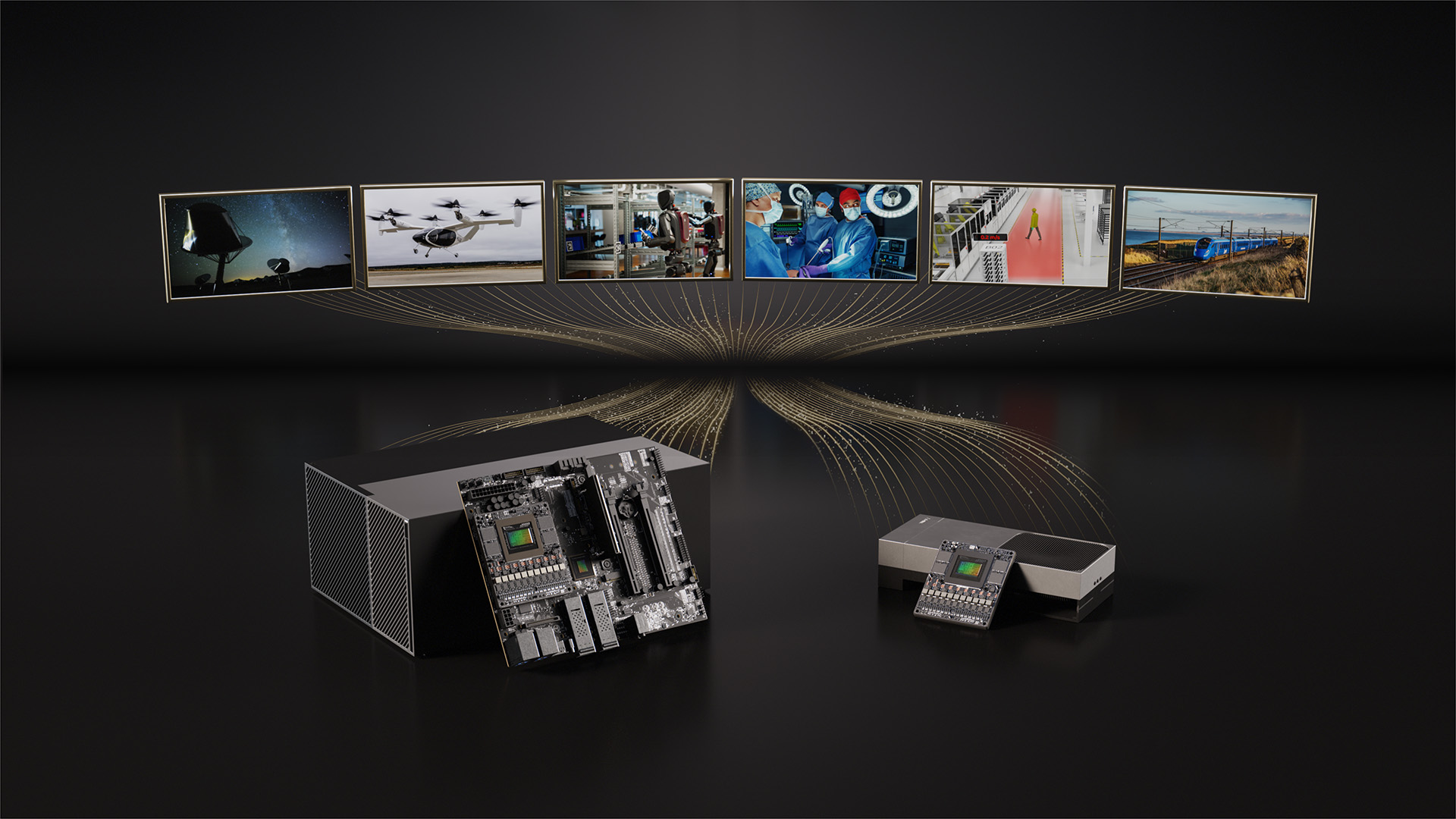
Across robotics, healthcare, and public safety, the common thread is production-grade edge infrastructure. Physical AI systems must run continuously, integrate with existing operations, support remote management, and provide a path toward safety-aware deployment. Inventec’s Edge IGX 2U Atlas Server, built on NVIDIA IGX Thor, is positioned to support organizations transitioning physical AI from prototype environments into scalable deployments.
To explore a deployment architecture or configuration for your use case, connect with Inventec for early engagement discussions.
|